References are added within the text in red.
In the e-book and physical book these appear at the foot of each page.
3: Kew To Hammersmith (7:00pm)
3.1. The Four Horsemen (of the GRiFTer Apocalypse)
"So that's a brief history of capitalism, George, which I hope you found enlightening?"
George offered a somewhat resigned nod.
"And I hope you can now see why we need to demystify it, rather than assume it's a fact of life just because that's what we've been told for the past 250 years. Just because it may have seemed a viable idea back then doesn't mean it's the answer to our problems today. The fact that we've got to the point when capitalism is killing the planet sure helps focus the mind as we look for an alternative."
"Couldn't agree more," confirmed George. "But that's the past, and as I've asked you several times now, sir…" George now ran a couple of steps in front of the Director and turned to face him. "WHAT'S THE FRIKKIN' ALTERNATIVE ???"
"It's coming, it's coming," replied the Director, holding his hands up in mock surrender. "Just a couple more things to get off my chest before I deal with that. Because I need to bring you bang up to date with just how crazy the whole thing has become."
"It gets worse?" George’s face fell.
"I'm afraid so," replied the Director. "To be honest, I'm just getting started."
"Shit…" was all George could think to say.
"Since Thatcher and Reagan fired the starting gun on the Big Bang and unshackled the beast, all sorts of horrors have unfolded, to the point that the global financial system is now completely out of control. We're looking at a Frankenstein's monster rampaging across the countryside, laying waste to everything in its path. And if we want to stop it before it's too late, we need to grab our torches and pitchforks and chase it out of town. I want to assure you that I have some solutions, but I hope you'll allow me a few more minutes to explain the problem before we get to the answers."
George rolled his eyes in disappointment but accepted this logic, knowing his hotel was now a little less than a mile away and that he'd soon be sitting down in a warm room with a plate of food in front of him. "Let's finish this," he said; a cliché he'd uttered in countless low-budget movies.
"Great! So here goes," said the Director, setting the scene for the season finale, "Until the 70s, you could more or less set your watch by the financial crisis that would come around every few years. There'd be a crash followed by ten years of unemployment, strife, child poverty, starving families, food banks, social decay and the rest of it…and then the Government would bail out the banks, using money taken from the poor in the form of taxes, until the banks could start to speculate again and we'd be back to square one, having the same recurring nightmare. Get the picture?"
"I'm beginning to," replied George.
"And that's precisely what the more astute political observers anticipated once Ronnie and Maggie (Ronnie And Maggie, Political Soulmates Devoted To Deregulation www.thecorner.eu) had got their clammy little hands on the levers of power. They knew that this time, in the late 80s and early 90s, we were about to discover what happens when you give uncontrolled capitalists dragons, already high on their own excesses, access to all-powerful internet technology: Utter chaos ensues."
At this, a distorted grimace came over George's face.
"Back in the day, traders stood on the stock exchange floor waving their arms like dervishes, buying and selling to their heart's content. And the worst damage they could do was to cause an occasional bankruptcy or, at most, a market crash. But in the 1980s, the computer changed the game entirely. The internet made electronic trading possible, which meant that capitalism was no longer constrained by time or space and, over the next 30 years, it became a self-determining and out-of-control monster that no one understood how to operate anymore, much like that computer HAL from 2001: A Space Odyssey. (HAL (Heuristically Programmed Algorithmic Computer) is a sentient artificial general intelligence computer in Arthur C. Clarke's Space Odyssey series that controls the systems of the Discovery One spacecraft and interacts with the ship's astronaut crew. https://en.wikipedia.org) And now, just like HAL, it's quietly killing us, and we can't switch it off. Moreover, it continually finds new ways to circumvent human attempts to restrain it, and this trend is only getting worse.
"Take AI, for instance. As it grows more widespread, it threatens jobs traditionally done by humans, which, I assume, you'd think is a bad thing. But not so the dragon capitalists, who see it as a fantastic opportunity to slash manufacturing costs. Meanwhile, practical concerns for humanity, such as societal collapse as workers become obsolete, are casually ignored. And the fact this conundrum remains unsolved perfectly illustrates the central flaw of capitalism: it's not designed to serve us. Rather, humanity has become just another resource, here to serve it. Something that became apparent very quickly after the Big Bang, creating what I like to describe as The Four Horsemen Of The GRiFTer Apocalypse:
G LOBALISED
R ENT-SEEKING
F INANCIALISED
T AX EVADERS
"That's why I call modern capitalists GRiFTers, you see?
Global, Rent-Seeking, Financialised, Tax Evaders.
GRiFTers! Get it? Clever, eh? I made that up all on my own," smiled the Director, clearly pleased with himself.
"Very good," replied George. "Catchy… Now, get on with it!"
3.2. Horseman # 1, Globalised (Winner Takes It All)
"The main thing Ronnie and Maggie failed to anticipate when they unleashed the Big Bang was Globalisation. (Globalisation refers to the increasing interconnectedness and interdependence of economies, cultures, societies, and people around the world. It involves the exchange of goods, services, information, technology, and ideas across national borders, facilitated through advancements in transportation, communication, and technology. Globalisation is a complex and multifaceted phenomenon that has profound implications for individuals, societies, and the global economy. Globalisation: A Very Short Introduction by Manfred B. https://academic.oup.com). Marshall McLuhan predicted it back in the 70s when he described a Global Village connected by electronic technology, which, he warned, would distort reality and create tension. But who cares about such trivialities when there's money to be made? (Marshall McLuhan (1911–1980) a Canadian philosopher and media theorist best known for coining the phrases "the medium is the message" and "the global village." https://marshallmcluhan.com)
"And sure, there was Globalisation before the Big Bang because, I guess, the East India Company was the first global corporation. One of its most notorious wheezes was to force Indian farmers to grow opium instead of food and then force the Chinese to exchange this opium for their tea, silk and porcelain. And, when, quite reasonably, the Chinese government said they didn't want tons of cheap opium flooding the market, causing widespread addiction, the East India Company started the Opium Wars and essentially took over China! (The Opium Wars were primarily triggered by the illegal opium trade conducted by British merchants in China. The Chinese government's attempts to suppress this trade led to military confrontations. They marked the beginning of the "Century of Humiliation" (1839–1949), a period of foreign domination and internal decline in China. www.historyextra.com) After that, they extracted taxes from the Chinese and, in return, gave them smallpox, measles and typhus! (There is historical evidence to suggest Europeans, including the British, inadvertently introduced diseases like smallpox, measles, and typhus to indigenous populations in various parts of the world, including China. Ecological Imperialism: The Biological Expansion of Europe, 900, 1900 Alfred W. Crosby https://www.goodreads.com) So yes, there was a sort of global corporation back then, but its modern successors carry on the tradition with demonic enthusiasm."
"Nasty," George shook his head.
"So Globalisation wasn't exactly new, but the scale of what's happened since the Big Bang has expanded the power of multinationals beyond anything previously imaginable.
"It's no exaggeration to say that multinationals now run the world's economy with little or no attachment to any one country. They are effectively above the law, and there's little any individual country can do about it. There's no loyalty or sentimentality when it comes to capitalism. They're called Multinationals for a reason: Profits before Patriotism. (A Multinational Corporation is a large company that operates in multiple countries, typically with a centralised management structure. These corporations have subsidiaries, branches, or affiliates in various nations, each contributing to the overall business objectives of the company. They leverage resources, technology, and capital from different regions to expand their reach, access new markets, and maximise profits. MNCs play a significant role in the global economy, influencing trade, investment, and employment patterns worldwide. www.ascotinternational.net)
"So now we have reached the point where two-thirds of the world's 100 largest economies are global corporations rather than physical countries. Apple, for instance, has a market capitalisation of around $3 trillion, which is roughly the size of Britain's or France's GDP, and its sole aim appears to be enriching a tiny elite beyond the vast wealth they already own, giving little consideration to their employees or the countries where they operate.
However, I must mention one exception to this rule: the special group of Chinese multinationals, such as Alibaba, Tencent, Huawei, and PingAn, which is a global insurance firm, for goodness' sake! And BYD, or Build Your Dreams: the world's top-selling electric car maker. All of them are just extensions of the Chinese State, so, in effect, the Chinese government is becoming a multinational in its own right.
"I'm not exaggerating when I say the whole world is now run by a cartel of East India Companies, operating above the law and, in that sense, not unlike the dragon in our film. In fact, if anything, these GRiFTers aren't our friends, they're more like enemies, with zero interest in our wellbeing beyond what we may be to them as customers." He shook his head.
"We should feel concern, disgust, even revulsion at how these out-of-control, anti-human organisations have hijacked our futures but instead we embrace them, as if they were somehow our carers and guardians."
He let the silence pause over that concept.
"This," he said, visibly exasperated, "is the crazy state of the world we're now living in."
"It does sound crazy," admitted George, "I don't think I've ever considered The Apple Corporation as anything other than the good guys." George was now feeling more than a little duped.
The Director was pleased George now seemed to be genuinely engaging with this uncomfortable and challenging idea. "We tend to view these organisations as a benign force for good, but in many respects, they are outright dangerous, and becoming more dangerous every day. With all that power should come great responsibility, yet they increasingly behave like callous bullies, mindlessly running amok. In fact, in many respects, it would be inaccurate to think of them as human at all. Certainly, they are nominally controlled by a CEO and a chairman at any given time."
"Or chairwoman," corrected George.
"Or chairwoman," conceded the Director with a nod. "But these company figureheads come and go; they're just a nominal signature at the bottom of the trading accounts, but fundamentally, these 'managers' are little more than useful idiots charged with fulfilling their only duty at the end of each financial year, which is to increase the value of the business." ("Useful Idiots" refer to individuals who unwittingly support an ideology without fully understanding its flaws. George Bernard Shaw and H.G. Wells were considered Useful Idiots by some because of their sympathetic views toward the Soviet Union under Lenin and Stalin. https://wordhistories.net)
"Are you sure?" George found it difficult to determine whether this was true, given how little he understood corporate finance.
"I'm afraid so." The Director derived no pleasure from delivering this news.
"It's dangerous to consider multinational corporations as entities built on human needs. That's simply not true. They exist outside the subjective world of human interaction, to the point that they're now, more or less autonomous, with little interest in normal people beyond their ability to pay for things."
"Really?" George was still unwilling to buy it.
The Director could see George still needed proof, so he fumbled through his memory banks to see if he could recall any of the hundreds of articles he'd read in The Economist, Financial Times, or Wall Street Journal, for examples of corporate malfeasance.
"OK," he said, relieved to have recalled one such event from relatively recent history. "Here's an example of what I'm talking about. Do you know the Unilever Corporation? They make Axe, Dove and Hellmann's Mayonnaise?" (Unilever is a multinational consumer goods company known for a wide range of household and personal care products. Founded in 1929, it's one of the largest companies in the world by revenue. Unilever's portfolio includes well, known brands like Dove, Lipton, Axe, Ben & Jerry's, and Hellmann's. www.unilever.com)
“Sure, and I'd like to credit a can of Axe Africa for getting me my first 'shag'; as you say over here."
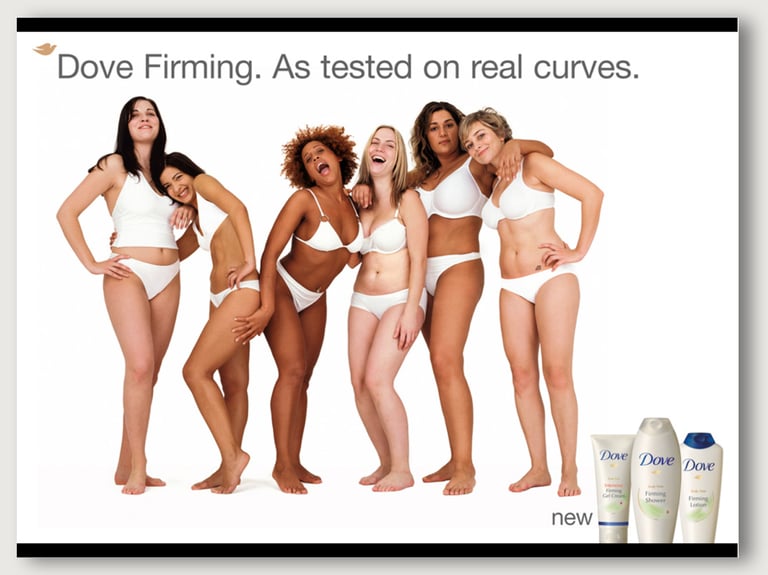
"Excellent!" exclaimed the Director, a little surprised and relieved. 'Well, around 2010, Unilever's CEO Paul Polman thought he'd capitalise on an ad campaign for Dove Soap that had featured a lot of ladies in their undies with, shock, horror! Diverse Body Types! This had been a big hit because it broke with the tradition of cosmetics companies (Unilever included) only using 'perfect' stick-thin models to sell their products, which, not surprisingly, had made many women feel inadequate."
George nodded, recalling the campaign.
"Polman takes this as a sign that modern consumers want a more honest relationship with brands and, next thing you know, he's proposing the company goes all-in on ESG.”
(ESG provides a set of standards that investors, customers, suppliers, and employees use to evaluate a company's impact on society and the environment, as well as its governance practices and supposedly provides a framework for organisations to demonstrate their commitment to sustainability and responsible business practices. www.ucem.ac.uk)
"ESG?" George looked confused. "Sorry, what? Extra Sensory Goop? Isn't that the name of Gwynny Paltrow's vagina candles?"
"Er, I don't think so," replied the Director, now equally confused. "ESG stands for Environmental, Social and Governance issues; it was a craze for a while for companies wanting to jump on the 'environment' bandwagon.
"You mean greenwashing bandwagon?" asked George.
(Greenwashing is a deceptive marketing practice where companies make false or misleading claims about their environmental friendliness. Companies engage in greenwashing to exploit growing consumer demand for sustainable products and improve their public image. https://plana.earth)
"Indeed," the Director agreed, "but I seem to be straying from the point I'm trying to make."
"Apologies," said George, "do carry on."
"That's fine, it shows you're paying attention."
"I am," George agreed, even if it wasn't altogether true.
"So when Polman stepped down in 2019, a Scotsman called Alan Jope took over and went even further in his efforts to make Unilever the greenest corporation on Earth."
"Sounds great," said George, "but is that a 'but' I hear coming?"
"Very perceptive, George. You're right because while Jope was busy trying to reduce the company's carbon footprint, source more sustainable raw materials and clean up his supply chain, the Unilever Board didn't think the company's share price was rising fast enough, making investors jittery. So, next thing you know, it's bye-bye Jope, and hello to whomever the next, less morally compromised CEO might be that was willing to take his place."
(Unilever's new CEO said the consumer products company's "aspirational" climate commitments have failed to deliver shareholder value and signalled an overhaul of the company's sustainability strategy that will leave more decisions to brand managers. https://trellis.net_)
"Pathetic," muttered George, shaking his head.
"Indeed," agreed the Director, "and that, my friend, in a nutshell, is how multinational corporations operate. They have no authentic morals or ethics and are only interested in new ideas that look like they might be profitable. For a while, Unilever thought being 'green' would make them money, but when that didn't work out, they went straight back to business as usual. Capitalism has no place for the sentimental or soft-hearted. They're more like soulless zombies than conscious human beings, a sort of money-making machine running on autopilot. Sure, there's a nominal crew sitting up front, pretending to steer the ship, happy to take their enormous salaries and bonuses for hitting their short-term targets, but they've little appetite for long-term projects designed to avoid ecological destruction or societal breakdown if they don't also promise a lucrative return on investment."
"I see." George sounded defeated, finally willing to accept the cold-hearted nature of multinationals.
Pleased that he'd made his point, the Director pressed on, wanting to elaborate further. "And the malign motivations of these multinationals are not restricted to making money. They are equally ruthless and cold-hearted when it comes to cutting costs. One of their favourite ruses is called offshoring,
(Offshoring is the practice of relocating business operations from one country to another, typically to take advantage of lower costs or favourable business environments. Companies often offshore functions such as manufacturing, customer support, IT services, and other back, office operations. www.indeed.com)
where they outsource labour and production to low-cost markets because it's simply a lot cheaper to make your products there; I think I read somewhere that in 2023, more than 95% of Apple's key products, including iPhones, AirPods, Macs, and iPads, were produced in China.
(Apple's Reliance On China Poses A Problem For The Company www.forbes.com)
And they aren't the only ones. Microsoft, Dell, Nike, IBM, Boeing and GE are all up to their necks in it because labour is cheaper in less developed countries, where there are fewer trade unions to complicate matters, and local authorities are more inclined to overlook sweatshops and similar practices. Essentially, it's the ideal setup for multinationals aiming to minimise costs while giving back as little as possible, in the form of taxes, to the communities they exploit and which most need it."
"Charming", muttered George in a desultory tone.
"What's more, it's standard practice for the likes of Apple, Microsoft, Amazon, Alphabet, Alibaba, BP, Shell, Walmart, Johnson & Johnson and the rest to bully the heads of G20 economies as if the multinationals were the masters and these heads of government were the servants.
"They achieve this by offering political carrots such as campaign donations, 'trade trips', and the promise of establishing a new headquarters in a deprived city. They also do it through sticks, threatening to relocate their factories elsewhere if they don't get the concessions they demand. All in exchange for influence over government decision-making, particularly regarding tax policies. The irony is that many governments will even help build these factories, using the income tax extracted from the same people who will ultimately work there on minimum pay.
"And, while all this is happening, zombie corporations spend as little time as possible considering their social obligations, with few, if any, showing concern for the environment, pollution, deforestation or habitat destruction. All of which are mere inconveniences that obstruct the business of making money. Is it any wonder we have global warming?"
"Fuck, fuck, fuck, fuck, fuck!" said George in exasperation. "What is wrong with these people?"
"Well, technically," corrected the Director, "as I've said several times now, they aren't people; they simply aren't human, and we need to stop seeing them that way. They're more akin to a self-driving car hurtling towards a tree, and no one seems willing to switch it to 'manual' and take over the steering. No one wants to be the voice of reason and stop all the fun. It all comes down to a lack of accountability. These behemoths operate above the law and across borders, moving their money and resources to wherever they can best avoid scrutiny and maximise profits. And they do it without any consideration for the broader consequences.
"Take the Ukraine War, for instance. When Russian oil supplies were sanctioned, global fuel prices skyrocketed, meaning that the working classes had to allocate a larger proportion of their income to refuelling their cars and heating their homes. The oil giants lamented how dreadful this situation was while, at the same time, miraculously raking in record profits: Disaster Capitalism at its finest, my friend."
"Essentially, whenever sanctions are imposed on the ability of these businesses to trade and make money, back channels (A back channel refers to an unofficial or informal means of conducting discussions and negotiations outside of formal channels, allowing for more discreet and flexible interactions between parties.) are opened, away from the public gaze, to get around restrictions and keep the exports flowing. For example, when the UK government stopped the export of components that Russian manufacturers needed to support Putin's special military operation, sales fell dramatically. However, when someone investigated where these British businesses were now selling these same components, they noticed that equipment was being exported to Uzbekistan and Georgia. Turns out, while British taxpayers are donating billions of pounds to Ukraine in the form of aid and weapons, British businesses are happily supplying the Russian army through the back door! (British firms' exports are almost certainly bolstering Russia's war machine in Ukraine, Sky data analysis finds https://news.sky.com) That's an excellent example of the immorality of capitalism, George. If the price is right, there's always a free-market dragon more than happy to make a killing, even if that means killing the little guys in the middle doing the fighting."
"Wow, that's weapons-grade capitalist bullshit right there!" exclaimed George, hardly able to believe what he was hearing.
"And there's almost no chance of these sanctions-busters getting caught because the regulators just don't have the resources to close the loopholes," added the Director, "especially given the revolving door (Power(ful) Connections: Exploring the Revolving Doors Phenomenon as a Form of State‑Corporate Crime https://link.springer.com) that allows the best people from the regulatory bodies to be lured over to the dark side where their knowledge of government systems make sure the multinationals stay one step ahead of the law and the tax man. If you don't believe me, the last time I looked, the Russian oligarchs were still sunning themselves on their yachts in the Med, enjoying their caviar." (An Oligarch is a member of a small group of wealthy individuals or families who control a disproportionate amount of economic or political power within a society. Once Upon a Time in Russia: The Rise of the Oligarchs and the Greatest Wealth in History by Ben Mezrich, the true story of the larger-than-life oligarchs who reaped the riches of privatisation after the fall of the Soviet regime. www.independent.co.uk/arts. Rich Russians by Elisabeth Schimpfössl review, where does all that money go?, A study, based on interviews, on how oligarchs are reinventing themselves as a cultural elite finds room to skewer their self, aggrandisement and patriotism" https://www.theguardian.com/books)
"Bastards," muttered George bluntly.
"And to stop us from asking too many awkward questions, these same GRiFTers employ an army of PR, advertising, and marketing agencies to put a friendly face on their household brands and cover up any anti-social behaviour they'd prefer their customers not to see. All of which would lead us to believe that these corporations are our trusted friends, but they aren't at all. In fact, when you think about how they are destroying our planet and lying about it to our faces, you'd probably be nearer the truth if you saw them as our enemies."
"Fuck," sighed George exasperated.
"I'm afraid so," said the Director, as though he was breaking the bad news to a five-year-old that Santa didn't exist. "They only care about us because they want our money. To them, we're just consumers, which is essentially marketing jargon for a unit of consumption. The more consumers they attract, the more products they sell, and the more profits they make, which, when tracked over a set time, is known as their profit ratio. Despite everything they'd like us to believe, this is the only thing they're really interested in."
"But isn't this an incredibly cynical way of looking at things, sir?" asked George, saddened by the thought of having been so systematically lied to over the entire course of his life. "I mean, I'm finding it hard to hate Tony the Tiger and Captain Crunch. I loved those guys when I was a kid."
"I hate to burst your bubble, but that's exactly what's been happening. Tony the Tiger and Captain Crunch never loved you in the first place; all they ever wanted was your money, and they were willing to say anything allowed within the law to get it. Frankly, you were simply being groomed by them."
Once again, "fuck," was all George could think of to say in response.
"You see, brands don't have feelings or a conscience; they're just cold, hard assets that generate profits, which, in turn, makes them of interest to investors looking to use the money they have sitting in their off-shore tax havens to make even more money, which then goes back to the tax haven. So investors look at a brand's ability to make a profit and, thus, how much they can sell it for to market speculators. That's all that this is about: that's the cold, emotionless world of the GRiFTers for you: How much can I buy this thing for, and how much profit will I make if I sell it?"
George shook his head as he listened to this, trying to come to terms with the banal reality that not only might Santa not exist, but that the guy in the red suit who sits in Macy's Christmas Grotto might be a psychopath!
"What's more, they don't mind being petty and cynical to their customers if it means making more money," continued the Director relentlessly, "so, they'll design products to fail, forcing us to buy what should be unnecessary replacements every few years. They'll change the ports on our phones so old chargers won't fit and glue down the batteries and seal up parts, making it impossible to repair them ourselves. And if, after all this, we are still loyal customers who have been with them for years, we won't be thanked; rather, we'll be penalised, paying more than the new customers they're trying to lure in. They'll quietly sell off our data, automate every touchpoint, and leave us shouting at emotionless chatbots when something breaks. And if we finally reach a human, it'll be a zero-hour, minimum-wage call-centre worker, scripted, stressed, and powerless to help us, who will nonetheless get the brunt of our anger as we scream into the void. In the eyes of the multinationals, we're not people, we're just cash cows milked 'til we're dry or until a regulator steps in and threatens them with fines for misconduct. Such is the lawlessness of multinational corporations. They owe no loyalty to anyone and exploit every opportunity, no matter how morally dubious, if profit can be made." (A "Cash Cow" refers to a product, service, or business unit that generates significant and consistent cash flows for a company with minimal investment or effort. They've generally captured a large share of the market and enjoy strong customer loyalty. www.investopedia.com)
George was now beginning to feel like he wanted to punch Santa in the face.
"And there's no chance of controlling them because the politicians are up to their neck in this game too, happily backing unregulated international corporations if there's a chance of it benefiting their career. There might even be a string of lucrative chairmanships or non-executive director roles waiting after leaving office, especially if they maintain ties with their successors."
George was now lost for words and had resorted to making a low, growling sound instead.
"Of course, these corporations claim to self-regulate their behaviour to save the planet. They claim that Adam Smith's market forces ensure they don't abuse the system and that their customers are their top priority. And if you believe that, I have some unicorn shit to sell you."
George felt dizzy from all this bleak and depressing information, but he had no counterarguments with which to challenge it, so he fell silent and felt sad.
3.3 Horseman # 2: Rent-Seeking (Money for Nothing)
"Ready for the second horseman?"
"If I must," replied George, knowing he was now stuck in the equivalent of a verbal 'doom scroll'. Do I have a choice?"
"Well, this one is called the Rent-Seeker, and while it doesn't sound terrifying, it's probably the one I like the least. (A rent seeker is an individual, organisation, or entity that seeks to gain economic benefits through manipulation or exploitation of the political, legal, or economic environment, rather than through productive economic activities like innovation or value creation. www.wallstreetoasis.com. Rent Extraction refers to the process of extracting economic rents from a market or economy without contributing significant value in return. www.youtube.com. Rent-Seeking By David R. Henderson www.econlib.org)
"Thinking about it, I was scared of the rent-seeking landlady who owned my first apartment in Brooklyn, but I wouldn't say she was exactly a horseman of the apocalypse. Though come to think of it, she did have big teeth."
"Well, in a small way, she falls into this category too, George, because Rent Seekers don't contribute anything to society. They cream off a rent every time we use the things they've monopolised."
"Hmm?" said George thoughtfully, still unsure why this was so bad.
"Well, I'm sure you know what it feels like to be on the wrong end of a game of Monopoly when your opponent has all the best properties.
"I know that feeling," confirmed George. "It isn't good, and there's nothing you can do about it."
"That's precisely it!" replied the Director. "You wield no power in this situation. The Rent Seekers are playing and a global game of Monopoly, and each time you land on one of their properties, you have to sell some of your assets just to stay in the game."
The Director considered whether he could find a better analogy. "So, imagine being near a river and having to cross a bridge to get to work."
"OK," George wondered where this was going.
"Well, imagine if the Mayor of your town decides to sell the bridge to a Rent-Seeker because he needs money to build a new hospital, and he's been made an offer he can't refuse."
"OK," he was still unsure where this was going.
"So the Mayor builds the hospital, and the Rent-Seeker now charges a toll every time you use his bridge."
"Ah!" said George. "I've seen this movie before. Every time I land on Liverpool Street, I must pay £10 for the privilege."
"Quite so! And every year, the price for crossing the bridge goes up because the Rent-Seeker has a monopoly on the bridge and there's no other way to get across the river."
"I can see how that is a problem," agreed George, "but at least we now have a hospital, and the Rent-Seeker has to maintain the bridge."
"That's true," agreed the Director, "and that's a good point, but the Rent-Seeker is now making far more profit from the bridge than it costs to maintain it, and before long, he'll use that profit to make the Mayor another offer he can't refuse, and they'll buy the hospital too!"
"Just like in Monopoly!" exclaimed George, now understanding the analogy.
"Precisely!" replied the Director, relieved George had finally got the point. "And the thing to realise is that the Rent-Seeker only bought the bridge because he knew it would make him money from charging rent on other assets. And yet, virtually nothing he does adds value to that bridge. He's just finding new ways to extract money from us that we wouldn't have to pay otherwise. And these parasitic rent-seekers are everywhere, pulling strings behind the scenes: Big Tech takes over our digital lives; banks skim fees for the privilege of using our own money; Big Pharma hides behind patents to delay cheaper generics; and energy and water giants pose as public utilities while charging monopoly rates, pocketing subsidies, dodging taxes, and raking in profits, without a whiff of competition."
"I guess it's easy when you have friends in high places," mused George.
"Exactly. Take Spotify. They charge a rent every time you listen to a song on their platform. Microsoft takes a rent every time you renew your software subscription. Facebook takes a rent...."
"I get the picture," interjected George, not needing any more examples. "The one I hate most is Ticketmaster. They don't seem to add anything to make buying a ticket easier, but they charge a 'handling fee' for the pleasure of getting in the way of what would otherwise be a fairly simple transaction… and then telling us how great they are"
"I agree. I fork out a small fortune to watch my humble little football club, Raith Rovers, and what do I get? Wall-to-wall self-promotion designed to brainwash me into thinking Sky Sport is fantastic, followed by a barrage of brain-dead adverts trying to turn me into a gambling addict. I'm paying to watch ads. It drives me up the bloody wall."
This made George laugh sympathetically as he recognised this in his own life.
"Most of the time, Rent Seekers are just middlemen, skimming money from ordinary people who'd get on just fine without them. But to me, the worst part of the Rent-Seeker model is that it's built on one simple trick: charging people for things they could otherwise get for free and could otherwise spend on practical things, like food or clothes. And that's why they're so desperate to get their hands on the NHS. Because they don't see accidents and illness as a problem to overcome together as a society, but as an opportunity to make money.
"Just like they do in the States," confirmed George, recalling the bills he'd had to pay for simple medical procedures.
"Can you smell something?" The Director changed the subject abruptly.
A little surprised, George sniffed the damp night air. "I can smell the Thames," he said. "It's a little funky, I guess."
"That's right," replied the Director, pleased George had taken the bait. "The river smells like shit because it's choked with sewage.
You see, the GRiFTers, who, in this case, are mostly investment and pension funds, bought Thames Water because it was easy money: a built-in monopoly with a sympathetic Establishment regulator, easily persuaded to turn a blind eye after a few cosy gentleman's club chats.
Their standard modus operandi is then to install a CEO who'll maximise profits by cutting the workforce to the bone, rehiring the rest on lower pay, longer hours, and less overtime, while investing the bare minimum to keep the taps running. And, predictably, they'll blow a fortune on PR to convince the public they're doing a brilliant job.
And if they pull it off? Those CEOs are rewarded with an enormous bonus for their so-called 'hard work'. (In charts: how privatisation drained Thames Water's coffers www.theguardian.com. England's privatised water: profits over people and planet www.bmj.com. The Standard View: Failing Thames Water has been rinsing us all www.standard.co.uk)
And what of the customers now forced to pay these new extortionate water bills? They've no choice but to cough up. Because there's no alternative."
"Leeches!" Shouted George, warming to this parasitic theme.
"By the way, Russia is what you'd call a rentier state because all of its assets are now owned by the rent-seeking kleptocrats who grabbed whatever they could when the Soviet Union collapsed. The oligarchs now rent those assets back to the Russian people and launder the profits they make, mostly through the City of London, I'm ashamed to say." (Rentier State is a term used to describe a country whose economy is heavily dependent on revenues derived from rents or external sources, rather than from productive economic activities such as manufacturing or agriculture. Rentier states often exhibit certain political dynamics, such as authoritarianism, clientelism, or rent, seeking behaviour, that are influenced by the concentration of economic power in the hands of the state. Rentier Capitalism https://en.wikipedia.org)
"And that's how Rent-Seeking works. It's almost impossible to calculate the size of the Rent-Seeking economy. (Kleptocrat is a term used to describe a ruler, government official, or individual who uses their political power to engage in corrupt practices and systematically steal or embezzle public funds or resources for personal gain.) Still, it's no coincidence that the four largest global companies are Apple, Microsoft, Alphabet, and Amazon, and all but Apple make the majority of their profits from charging rent for the use of their platforms, with Apple making about a quarter of its profits from its services. (In 2024 Apple's Services brought in $96.2 billion and saw the fastest growth, with revenue rising 13% year-over-year. This segment includes the App Store, iCloud, Apple Music, and advertising www.visualcapitalist.com) But here's the thing: They don't take all your money in one go, which would be too obvious. Instead, they adopt a long, slow, drip, drip, drip approach, which is less noticeable and easier to overlook. Given the chance, they'd suck us dry in one go, but that would be too obvious, so they are happy to play the long game. Call me old-fashioned, but I was always taught to value things made with love and skill, and that offer real benefits. Rent-Seeking makes no attempt to do any of that. Instead, it simply takes advantage of monopolies, creaming off trillions from the limited wages of the working class, mostly by getting in the way and making a nuisance of themselves. Nothing in this life is certain except death, taxes and online subscriptions."
"Well, just like this river, I think that stinks," observed George drily. "It's like the Invasion of the Body Snatchers , where everyone's out for my soul. Now that you've pointed that I'm being slowly bled dry, I see how insidious it is." ("Invasion of the Body Snatchers" is a classic science fiction horror film released in 1956, directed by Don Siegel in which alien seed pods land on Earth and replace humans with emotionless duplicates while they sleep. These duplicates are exact physical copies of the original humans but lack any individuality or emotions. It was designed as a critique of Communism https://en.wikipedia.org)
"Insidious! That's a perfect way to describe it!" the Director said, pleased with the word choice. "You'd think they'd be ashamed of how they make their money, given they're just glorified pimps. But, of course, they aren't ashamed at all; they're proud of themselves because it has made them unimaginably wealthy, and they've done it through minimal effort of their own. But this is how a hyper-capitalist GRiFTer society works, and that's all that matters."
3.4. Horseman # 3: Financialisation (Take the Money and Run)
"Pointless middlemen," reflected George, underlying the Director's assessment. "I'm afraid to ask, but what's this Financialisation about then?" (Financialisation refers to the growing influence of financial markets, institutions, and motives in the operation of domestic and international economies. It involves the increasing dominance of financial activities, such as investment, speculation, and financial engineering, over traditional economic activities related to production and consumption. Financialisation: A Primer https://www.tni.org)
"Well, I'm glad you asked," smiled the Director in appreciation of this good-natured gesture. "This is a biggie, so strap yourself in."
George mimed the act of putting on a seat belt, making a clunk-click sound, and looking ready for action.
"Without wanting to get too technical about this, Financialisation is a form of Rent Seeking."
"Really?" asked George, a little surprised. "If it's just more Rent Seeking, why consider it a separate horseman?"
The Director looked up, surprised. "A good question."
Perhaps he'd underestimated the American?
"I did think about that when I was writing the screenplay", he explained, "but in reality, all four horsemen are a sort of Russian doll, each fitting inside the other. It's an ecosystem where GRiFTers keep us in the dark and exploit us whenever the opportunity arises!"
"God, that sounds dramatic!" exclaimed George. "You're going all Matrix on me again!"
"Well, let me explain it, and then you can decide if I'm exaggerating."
"OK, convince me," invited George amiably.
"OK, so Financialisation describes how the world economy is now dominated by GRiFTers looking for ways to make money out of money. Take bankers, for example; I'm sure you know how they make their money, which is certainly not through sitting on a pile of cash and handing out dollar bills whenever you give them a cheque to cash."
I haven't cashed a check, as we say in the States, since 2004!" laughed George, "but I know what you mean."
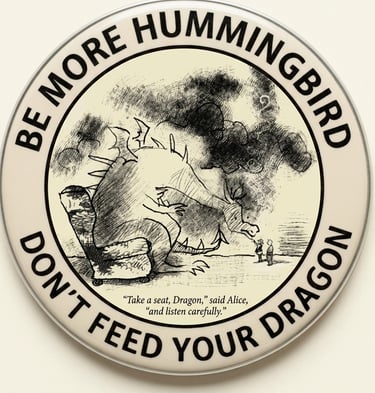
"Well, exactly, but as Alice explained in our film, banks make money out of speculating, which is just another word for gambling. You think a horse will win the Kentucky Derby, so you bet $5 on it, and if it wins, you get $20 back. It's the same for stocks and shares. If you think the war in Ukraine will make oil prices jump, you might buy $5 worth of shares in Tesla. Then, if you're right, and there's a bloody stalemate that causes the price of oil to go up, the stock price of electric cars will go up too, and the $5 of Tesla you own is now worth $100. Congratulations! You've just made $95 out of thin air, you made money out of money. Result: happiness. And that's financialisation."
"But that's just how banks operate," observed George. "There's nothing wrong with that. If people couldn't borrow money from a bank, they wouldn't be able to start a business and make their own living. That's how the economy works."
"You're right," agreed the Director. "That's certainly how it worked in the old days anyway, when banks were still interested in bricks and mortar. But now, since the Big Bang, deregulation, and the advent of the internet, the entire world economy has become a massive supernova explosion of speculation.
"Banks used to make money buying and selling physical things; now they're only interested in making money from financial instruments such as 'options', 'futures', and 'derivatives'. They're less messy and certainly more profitable than buying and selling dirty old factories.
"And it's not just the banks that are interested in speculation. These days, there are investment banks, insurance companies, pension funds, currency traders, hedge funds, private equity firms, global investors, and sovereign wealth funds, all feverishly looking for the next big payday. And don't get me started on the Global Investment Management Companies such as BlackRock, Vanguard, and Fidelity Investments. Oh, if only those outfits called themselves Partners, then their collective acronym would be GIMP, which would just about sum up these fabulously rich deviants with an unhealthy fetish for money."
At this, George let out a snort of suppressed delight before asking, "So who are these GIMPS, pray tell?"
"Oh my god, the likes of BlackRock manage the investments from pension funds, oligarchs and billionaires who want to make even more money from the enormous amounts of money they already own. To go back to my earlier horse racing analogy, BlackRock and their ilk are a sort of incredibly wealthy and privileged bookmakers placing bets on behalf of their clients. But, instead of putting $5 on the favourite for the Derby, they gamble with over $ 11 trillion a year, making their living from betting on the system. Rather cosily, they also advise governments about what's happening with the world economy. (BlackRock is one of the world's largest investment management companies, offering a wide range of investment products and services to institutional and individual investors worldwide. Founded in 1988 and headquartered in New York City, BlackRock has grown to become a global leader in asset management, with operations in more than 30 countries and over $10 trillion in assets under management. www.blackrock.com)
"A couple of years ago, the head of BlackRock, a guy called Larry Fink, had an attack of the vapours and let it be known that he was now more likely to invest in companies which showed a genuine commitment to reversing climate change. As a result, a whole new industry called ESG, which I mentioned earlier in relation to Unilever, emerged to help multinationals clean up their act. ESG, if you recall, stands for Environmental, Social, and Governance. Well, some hope of that. Rather than seeing this as an opportunity to help the planet get back on track, these multinationals, with the help of their specialist ESG consultants, developed new ways to exploit the system, particularly through a loophole called Carbon Trading. Eventually, Fink realised it was impossible to tell who was green and who was just greenwashing. So he threw in the towel, and everything reverted to stinking capitalist normality. Meanwhile, average global temperatures continue to rise. (Greenwashing refers to the practice of misleadingly portraying products, services, or corporate activities as environmentally friendly or sustainable when, in reality, they may not be as environmentally beneficial as claimed. Explainer: Greenwashing: deception and vague promises that do not help the environment www.reuters.com)
"Carbon Trading is an excellent example of how the rules and regulations don't apply in the world of high finance. If there's a profit to be made, the GRiFTers will find a way to make it, simply by creating new rules which justify exploiting it. Take those subprime products I mentioned earlier when I described the financial crash of 2008. Subprime products were merely a way of bundling bad debts and magically transforming them into bankable assets. This is just one of the hundreds of schemes that fall under the derivatives banner, (Derivatives are financial instruments whose value is derived from the value of an underlying asset, index, or reference rate. These instruments are used for hedging, speculation, and investment purposes, allowing investors to manage risk, gain exposure to different markets, and potentially enhance returns. Derivatives: A Primer https://treasurytoday.com) such as futures, swaps, and options, all of which are too complicated and, frankly, too dull to go into detail about. The critical thing to know about them is that they're just different ways to magic money out of thin air; ironic given that these genius economists and bankers like to present themselves as rational and level-headed, making business decisions based on hard facts and numbers. But don't be fooled. It's just a mirage wrapped in a three-piece suit and red braces. These hard-headed businessmen claim to deal in facts, yet, at the same time, they're happy to entertain ideas like Quantitative Easing (which is just a euphemism for printing money) (Quantitative Easing (QE) involves buying 'bonds' (known as 'gilts' in the UK ) which are a form of 'IOU'. Between 2009 and 2020, the Bank of England bought £895 billion worth of bonds using money it created digitally (from what it called 'central bank reserves') in order to stimulate the economy. This undoubtedly benefitted asset owners and investors more than savers or wage earners. What is quantitative easing? www.bankofengland.co.uk) and Invisible Hands and Animal Spirits, (Animal Spirits is a term coined by the British economist John Maynard Keynes he used to describe irrational economic decision, making which contribute to fluctuations in economic activity and cause things like financial bubbles. Animal Spirits: Meaning, Definition in Finance, and Examples www.investopedia.com) none of which would be out of place in a children's fairy story. Yet when their precious capitalism is criticised, and someone suggests a Circular Economy or Degrowth as a potential alternative, they throw their hands in the air and claim that ideas of this sort are pure fantasy. Well, they can't have it both ways."
(A Circular Economy is a systemic approach to economic development designed to benefit businesses, society, and the environment. In contrast to the 'take, make, waste' linear model, a circular economy is regenerative by design and aims to gradually decouple growth from the consumption of finite resources. www.ellenmacarthurfoundation.org)
(Degrowth is a political and economic theory that emphasises changing priorities of society from economic growth and production to a society based on sustainability, well, being, concern for the environment and cooperation. The motives for pursuing degrowth include the need to provide environmental sustainability for the long term and improve quality of life. Critics argue degrowth is a luxury of the middle classes and many very poor still need to see economic growth to lift them out of poverty. www.economicshelp.org)
"Sounds like the Mad Hatter's Tea Party!" said George, perceptively, still plodding along and listening intently.
The Director turned to George. "You're so right."
"These days, Wall Street and the City of London are more like scenes from Lewis Carroll than a serious place where rational grown-ups have our best interests at heart."
At this point, George was beginning to look increasingly like the White Rabbit as he rechecked his Richard Mille watch, concerned that the restaurant would still be open when they finally arrived.
"Financialisation just describes how the GRiFTers have got their finger into every little corner of our lives, from the water we drink to the fossil fuels we burn and the personal data they harvest from us. Walk down any high street and look at all those stores and supermarkets. You might think of them as individual businesses, but most are owned by investment companies with about as much interest in high street retail as I have in the Kardashians. They do not care about shoppers or shops per se; all they're interested in is their return on investment , (Return on Investment (ROI) is a financial metric used to evaluate the profitability or efficiency of an investment relative to its cost. It measures the return or gain generated from an investment compared to the initial investment amount, expressed as a percentage or ratio. ROI: Return on Investment https://www.investopedia.com) buying and selling businesses, not for anything as prosaic as providing a service to society, but simply to make money. And, as I've said, these returns can always be improved through greater efficiencies such as redundancies, automation and cheaper raw materials. And you can now add to that a trend I've spotted recently called shrinkflation."
"Shrinkflation?" George looked bemused.
"Yeah, shrinkflation, when, instead of putting up their prices, a lot of retailers do sneaky things with their packaging, which makes a box of detergent or a tube of toothpaste or a bar of chocolate look the same size when it might be 10% smaller."
(Shrinkflation, is an economic practice where manufacturers reduce the size, quantity, or quality of a product while maintaining its original price or slightly increasing it. https://corporatefinanceinstitute.com)
"So?" George was trying to understand.
"So, now the supermarket is charging the same amount for a product that's got 10% less in it!"
"Sneaky bastards…" George muttered quietly to himself as the penny dropped.
"It's just the latest cynical way for them to keep their profits flowing. And what do they do with these extra profits? They squirrel them away in their offshore tax havens, contributing as little as possible to the customers' lives they've just ripped off. In the world of GRiFTing, there's nothing that can't be exploited for financial gain. Nothing is out of bounds. It's called the commodification of life."
(The commodification of life refers to the process by which various aspects of human life, such as health, relationships, nature, and even personal identity-are turned into commodities. Medical services, once seen as a basic human need, are often commodified, leading to inequalities based on the ability to pay. Personal Identity: where companies profit from personal information and experiences. Natural resources: Water, land, and air are often privatised and commercialised. Surrogacy and egg or sperm donation for profit are further examples. https://prospect.org)
"Sneaky bastards" repeated George, trying to process this latest revelation.
"Financialisation has taken over the world, George, and technology is driving it further from our day-to-day reality. High-frequency trading utilises powerful computers and algorithms to buy and sell stocks and shares within milliseconds, aiming to generate small profits on each transaction over a very short period. It's a crazy way to make money, but it now represents about two-thirds of all financial activity on the planet."
"The Matrix!" blurted George in surprised recognition.
"I told you!" Confirmed the Director with a hollow laugh. "In the 1980s, the average stock was held for four months. Now, it's all happening in less than a second, and it's all happening without anyone watching or being in control. It's a world where things aren't created for their actual value or benefit to society but for how much they can be traded, speculated on, or rented out. And all of it happens without humans having any say in the matter.
"And naturally, this is where the multinational GRiFTing corporations thrive, shuffling cash and resources across borders, manipulating digital funds that slip past government oversight, and ensuring they pay as little tax as possible."
"And that, George, is Financialisation."
The Director paused for breath; whenever he reminded himself of the shit-show world he now lived in, it always pushed him into a sloth of depression so, for the next couple of minutes, the two gloomy thespians walked on, lost in thoughts, staring at the lights reflected in the river.
3.5 Horseman # 4: Tax Evasion (Getting Away With It)
Eventually, George broke the silence. "That stinks!" he said.
"The river or the GRiFTers?" the Director asked, somewhat amused.
"Both!" replied George, "But mostly the GRiFTers. The river shouldn't stink. We shouldn't be polluting rivers in this day and age. That was something we did a hundred years ago. I thought society was supposed to evolve, but we seem to be going backwards."
"We ARE going backwards," confirmed the Director. "Since the Big Bang, the GRiFTers have taken over the world, turning it into a dehumanised financial space of balance sheets divorced from reality.
"They don't care about rivers, the fish that live in them, the people who might want to swim in them, or even, heaven forbid, the people who hope to drink the stuff. They don't even care about climate change and the fact that their behaviour is slowly killing us. All they're interested in is profits. Profits, profits, profits, profits and nothing else matters. Capitalism is like HAL from 2001. We've given it enough power to do as it pleases, and that's exactly why it is going to do, and it won't stop until we're all dead. There's no 'OFF' switch for capitalism."
"So what can we do about it?" George was still hoping for the elusive answer the Director still seemed unwilling to reveal.
"Bear with me, George, because I'm coming to that, and I honestly believe I've found this crazy system's Achilles Heel, so I hope you don't mind if I take one more minute to describe this last horseman?"
"Oh, of course. I was so pissed off after the first three, I almost forgot there was a fourth!" replied George sardonically.
"Thanks," acknowledged the Director, "because unless we understand what we're up against, we might not be angry enough to want to stop it."
"Agreed" He accepted this logic.
"OK, this last nasty little horseman is called Tax Evasion, which is relatively self-explanatory but has become an industrial-scale scandal on steroids that now threatens our very existence. At least, it ought to be a scandal, but the reality is that everyone now seems to take it for granted as though it's legitimate behaviour, which is an even bigger scandal.
(Tax Evasion, the illegal practice of deliberately underreporting income, inflating deductions, or concealing assets to reduce tax liability and evade paying taxes owed to the government. HMRC has not charged a single company over tax evasion under landmark legislation www.theguardian.com)
"When you think about it, it's pretty weird to think that tax havens are tolerated in this day and age. It's essentially a feudal concept where the wealthy are granted 'special' places where they can hide their money so they don't have to give any of it back to the people who helped make them rich. It's sick. But it's all perfectly normal.
"As I've already mentioned, thanks to Globalisation, Rent Extraction, and Financialisation, it's no longer possible to track who owns what, and this loophole conveniently makes it much easier for unscrupulous individuals and corporations to hide their money from the tax authorities. They take the rent they extract from us, but instead of paying taxes on that unearned profit, as any upstanding citizen might be expected to do, they quietly slip off to the Cayman Islands and stash their swag away there, where no one can see it."
"Bastards," repeated George, although it didn't sound too bad coming from an American with an American accent.
The Director nodded. "Tax Evasion has almost become an art form, and given the number of creative accountants paid to find loopholes to get around the rules, I'm surprised one of them hasn't won the Turner Prize by now! It's a game of cat and mouse, where GRiFTers use third parties, obscure tax laws, and elaborate subsidiaries in low-tax regions, among other wheezes, to evade what any decent individual would feel their duty to pay. But rules like that are for the little people and don't apply to GRiFTers.
"So it's a game of cat and mouse, but the cat's a Bengal tiger, and the mouse is a… a… dormouse," suggested George, realising his analogy may not be perfect.
"Quite," the Director agreed sympathetically. "The explosion of the digital economy and cryptocurrencies has made it all the easier for the wealthy to game the system. No one knows how much corporate tax evasion costs, but it's at least half a trillion dollars a year. Yet, instead of punishing these tax cheats, who'd surely be jailed if they were regular members of the public, governments typically look the other way when it comes to GRiFTers. And all of this nefarious activity is protected by the cultural hegemony that stops us from asking too many difficult questions."
(Cryptocurrencies or virtual currencies operate on decentralised networks based on blockchain technology. Unlike traditional currencies issued by governments (fiat money), cryptocurrencies are not controlled by a central authority, such as a central bank. www.investopedia.com)
"The Heggy, what now?" George pulled a face.
"Hegemony, George; it's a Wizard of Oz sort of thing, but we'll come to that later."
You are welcome to share the free digital version of this book, but you may not claim it as your own, modify it, or sell it. We don't track you or sell your data.
Copyright & Legal © 2026 The Hummingbird Effect. All rights reserved.