Synopsis

Part fable, part manifesto, part late-night pub conversation that's hard to ignore.

Spoiler Alert! - Reading this synopsis may spoil your enjoyment of the book. The book is a lot funnier than this!

The Dragon & The Hummingbird

Overview

The Dragon and the Hummingbird is an urgently relevant book about climate change but not as you may have read about it before. This book blends satirical fiction with a wide range of accessible ideas from philosophy, politics, history and science to make the case for individual and collective action in the face of corporate greed that is causing environmental catastrophe.

The Fable

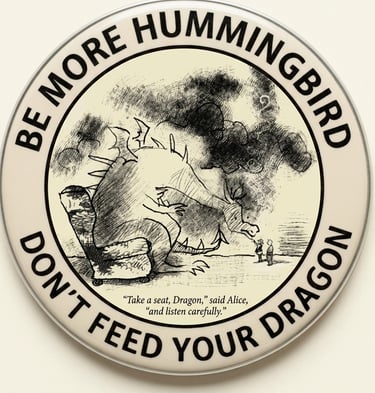
Part One: The Dragon opens as a darkly comic fable. Alice, a journalist-turned-reluctant corporate spouse, and her husband George, an idealistic environmental consultant, find themselves drawn into the orbit of K, the dragon at the heart of Komodo Industries. K is no metaphor: he is a literal, coal-chomping, fire-belching dragon in a suit, whose real power lies in his ability to cast a spell of glamour, wealth and status over those around him. George falls under K's influence, climbing the corporate ladder while Alice digs deeper into Komodo's catastrophic environmental malpractice. As George's transformation into a compliant corporate drone accelerates, Alice, inspired by their daughter Evie's love of The Brave Little Hummingbird, begins her own quiet resistance. Eventually, George awakens to what he has become, breaks free of the dragon's spell, and both he and K are forced to confront the consequences of their choices. The story ends not with a dramatic battle, but something more radical: personal responsibility.

He argues that while the majority is "comfortably numb" with consumerism, they hold the actual keys to salvation. The Director asserts that victory won’t come from sitting on the fence (the "fence is on fire"), but from the collective mobilisation of this middle group. If the Eco-Worriers transitioned from paralysed awareness to concerted pressure through daily choices, they could stop the crisis entirely. The chapter highlights the Director's shift from elitist frustration to a desperate mission: empowering the average person to recognize their own latent power.

The Dragon and the Hummingbird – Chapter 1

At the beginning of the 'Explainer' part of the book we realise the previous story about the dragon had been a movie, and that what we are seeing now is the conclusion of its filming.

We are at a wrap party for the climate-themed thriller, a cynical Scottish Director faces a harsh realisation: his leading man, George, didn’t understand the movie’s message. George’s confusion serves as a wake-up call; if the Director can’t reach his own star, his movie will fail to warn the public about climate change. So he decides to explain it carefully to Geoirge. We listen in on their conversation.

To explain the audience, the Director sketches a bell curve on a script, mapping the sociological response to the climate crisis:

  • The Resistance: Radical activists taking direct action.

  • The Collaborators: Capitalists profiting from denial.

  • The Eco-Worriers: The 90% majority—ordinary people who feel "inertia."

Chapter 2 – Twickenham to Kew

As the studio empties, the jaded Director leads George on a walk along the river, framing the climate crisis as a collective, consumer-induced trance. He argues that society is "sleepwalking" toward a cliff, sedated by tech algorithms and a "commodity fetishism" that acts as a modern-day soma. We remain "asleep" because the truth of our addiction is too painful to face.

The Director employs a sharp analogy: Capitalism as an Operating System. Like Microsoft Windows, he argues, fossil-fuel capitalism dominates not because it is the "best" or most efficient system, but because legacy energy firms have the financial might to suppress competition and cleaner alternatives. This isn't an ideological rant, he insists, but a matter of common sense. The climate is indifferent to wealth and will claim the rich as easily as the poor.

In a rare moment of insight, George offers Aesop’s Fable of the North Wind and the Sun, suggesting that gentle persuasion (the Sun) is more effective than force (the Wind) in convincing people to change their behavior. As the walk continues, the enormity of the crisis finally dawns on George, who realises his comfortable worldview is being systematically dismantled.

Chapter 3 - Kew to Hammersmith

Continuing their walk, the Director characterises modern capitalism as an "out-of-control monster." He introduces the Four Horsemen of the GRiFTer Apocalypse, focusing on the first horseman: Globalisation.

He defines "GRiFTers" as entities that are Globalised, Rent-seeking, interconnected, Financialised, and Tax-evading. These corporations have outgrown national borders; currently, two-thirds of the world’s 100 largest economies are corporations like Amazon, not countries. This scale allows them to operate above the law, prioritising profit over patriotism.

The Director labels these entities "soulless zombies." Using Unilever as a case study, he explains how CEOs who prioritized sustainability (ESG) were eventually thwarted by shareholders demanding faster returns. In this "Frankenstein" system, humanity is merely a resource. He warns that "dragon capitalists" view emerging technologies like AI solely as tools to slash labour costs, indifferent to the potential for societal collapse. By offshoring production to the cheapest markets, these corporations prove they lack authentic morals, existing only to feed the bottom line while workers become increasingly obsolete.

Chapter 4 – Hammersmith to Battersea

The Director frames late-stage capitalism as a "malignant system" in its death throes. He argues that politicians aren't just failing to stop the "GRiFTers" they are their accomplices. Citing Marx’s 1840 predictions, he illustrates a world where monopolies have triggered systemic collapse, evidenced by crumbling infrastructure, soaring inequality, and the rise of populist "grifters" like Donald Trump.

The Director mocks the absurdities of this era, where "premium bottled air" and corporate "mental health weeks" mask a brutal reality. George observes a grim evolution of Marx’s theories: while religion was once the "opium of the people," today’s masses use actual opioids and digital content to numb the pain of a broken dream.

This "Distraction Machine" ensures the public remains passive.

The Director insists that modern politics offers only an illusion of choice comparing left and right wings to "different flavours of the same TV dinner," both tethered to the same greed-based engine. As the walk continues, George feels the weight of this "Matrix-like" reality, realise that he has been sleepwalking through a world designed to keep him quiet, comfortable, and complicit.

Chapter 5 - Late-Night Meal

In a restaurant, the Director dismantles the obsession with Gross Domestic Product (GDP) as the primary metric of national success. He labels GDP a crude "clipboard" that tracks the total value of goods and services while ignoring societal and environmental health. He argues that a rising GDP simply indicates the "pie is growing" for the wealthy elite, often correlating with increased greenhouse gas emissions rather than improved quality of life.

The Director introduces the Easterlin Paradox, explaining that while income growth initially boosts happiness, the effect plateaus once basic needs are met. Both men acknowledge that their significant wealth has not prevented feelings of misery. This leads to a critique of the "hedonic treadmill," where advertising creates a sense of inadequacy to keep consumers trapped in a cycle of constant purchasing.

As an alternative, the Director suggests the Human Development Index (HDI), which prioritises life expectancy, education, and living standards. He cites Nordic countries as examples of holistic success. The chapter concludes with George ordering a "Chocolate Bombe," a playful attempt to find immediate sensory comfort while grappling with the heavy realization that true happiness stems from connection and contribution rather than consumption.

In Chapter 6 - The Nightcap Pt.1

In this chapter, the Director provides the final piece of the jigsaw by shifting focus from elite puppet masters to individual responsibility. He argues that society is caught in a capitalist pyramid scheme fuelled by personal greed. To fix this, he suggests a Truth and Reconciliation process where individuals acknowledge their own selfishness. This personal dragon, he claims, is what feeds the global capitalist dragon.

The Director uses the history of the board game Monopoly to illustrate his point. While an alternative version called Prosperity existed to promote cooperation, players ultimately chose the version centred on bankrupting others. He argues that human selfishness is not a law of nature but a cultural choice.

To provide historical context, he contrasts Adam Smith’s justification of greed with the work of Adam Ferguson. In 1767, Ferguson warned that a narrow focus on money makes people weak and dishonourable, arguing instead that societies flourish through social bonds and cooperation.

The chapter concludes with a personal confession. The Director reveals that he once worked in advertising, where he spent years flogging empty dreams to the masses. This background in the art of persuasion sets the stage for his final explanation on how to dismantle the current system and change the world.

In Chapter 7 - The Nightcap Pt.2

The Director, George, and a bartender named Faye examine why systemic change remains so elusive. The Director argues that Karl Marx’s predicted revolution never materialised because the financial elite proved far more adept at maintaining power. Through gaslighting and cultural hegemony, they successfully sold the capitalist dream to the masses, effectively turning potential revolutionaries into passive consumers.

The conversation explores how individuals are born into a pre-existing reality where capitalist rules are presented as absolute truths. This hegemony ensures most people never question the system, even as it actively fails them. Reflecting on the historical "Sliding Doors" moment between the philosophies of Adam Smith and Adam Ferguson, the Director suggests that our current path was a specific choice rather than an inevitability, meaning different choices can still be made.

Crucially, the Director insists that the climate crisis is a matter of survival rather than ideology. He argues that the solution does not lie in vilifying entrepreneurs or inciting class war. Instead, he positions his plea as that of a human being who simply wants to stay alive. The chapter concludes with the stark reminder that political allegiances vanish when a gun is pointed at one's head, which is exactly how he views the current environmental state.

In Chapter 8 - The Elevator Pitch

The Director concludes his late-night symposium by framing the climate crisis as the inevitable result of a capitalist system that prioritises profit over human survival. As the walk ends at 2:00 am, he reiterates that the current model is no longer fit for purpose and leads directly to environmental Armageddon.

To combat this, he introduces the concept of the individual as a hummingbird. He urges George and Faye to act like the small bird in the fable, taking consistent, manageable actions to douse the fire rather than remaining paralysed by the scale of the problem. He argues that waiting for top-down initiatives is a recipe for failure.

Drawing on historical precedent found in the abolition of the slave trade, the suffrage movement and the strategy used by Mahatma Gandhi to successfully evicted the British Empire through non-violent disobedience and collective non-cooperation. These serve as a blueprint for the climate movement; even the most powerful capitalist dragon can be defeated if enough people refuse to participate in the destructive status quo.

Despite his exhaustion, George expresses deep gratitude, signalling that the deprogramming process has succeeded. The chapter transitions from theory to practice, asserting that while the threat is existential, a collective shift in behaviour can still slay the dragon.

The Wrap

At its heart, The Dragon and the Hummingbird asks one simple question: What difference can one hummingbird make? Its answer: everything, if enough of us show up, is both a rallying cry and a practical invitation.

The story is wrapped in an engaging dialogue between amusing characters which moves the story along and delivers the core message without being too much of a lecture or diatribe.